
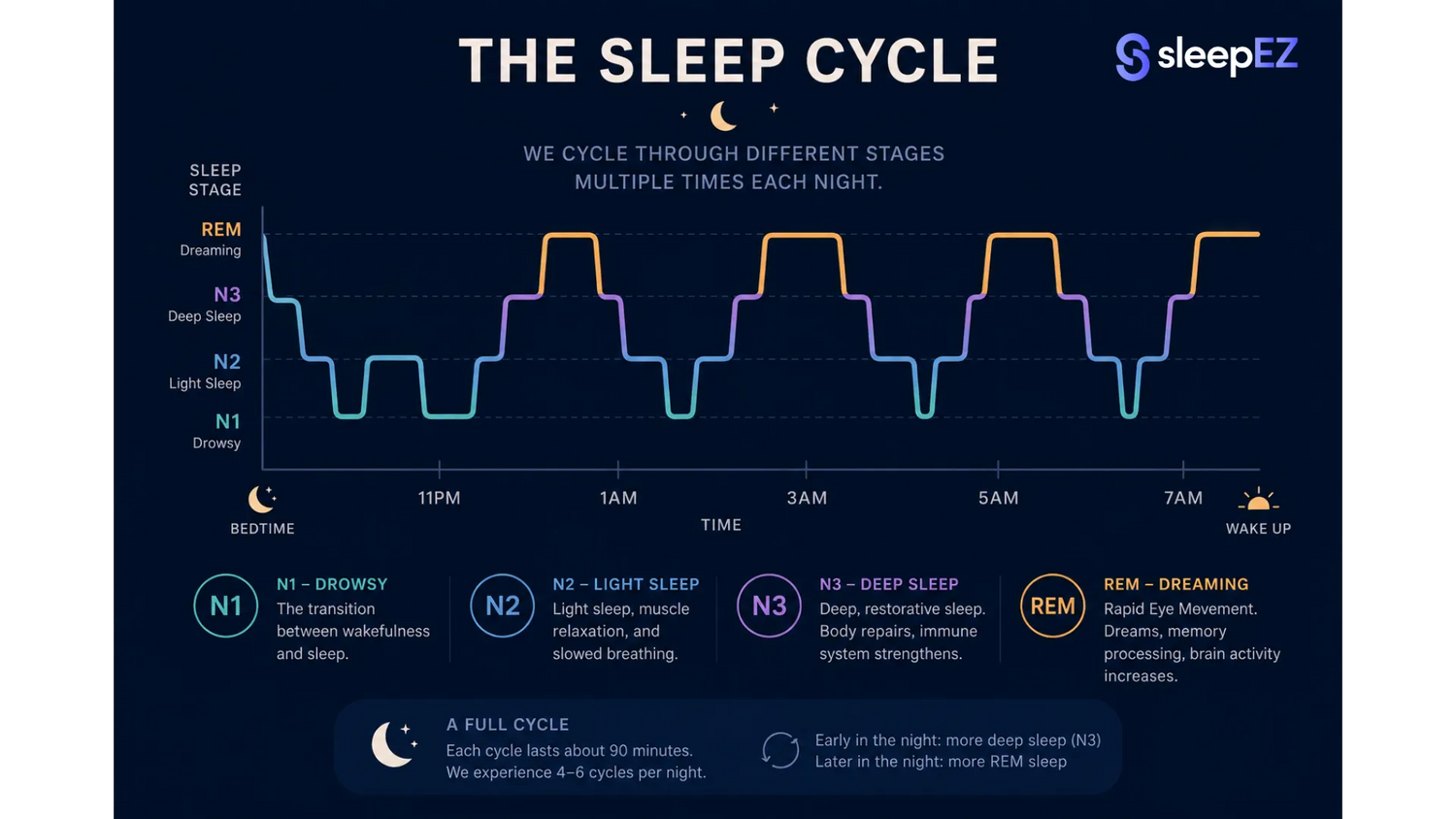
Sleep isn't just an off switch for your brain. It's a complex process that moves through distinct stages, each serving a different purpose for your body and mind.
Every night, you cycle through two main types of sleep: NREM (Non-Rapid Eye Movement) and REM (Rapid Eye Movement). Most adults complete 4-6 full cycles per night, with each cycle lasting about 90 minutes.
Understanding these stages helps explain why you might wake up feeling refreshed some mornings and groggy on others. The quality of your sleep depends on moving smoothly through all four stages multiple times each night.
Quick Answer: What Are the 4 Stages of Sleep?
Sleep occurs in four stages that repeat in cycles of approximately 90 minutes throughout the night:
- N1 (Light Sleep), 1–5 minutes, the transition from wakefulness
- N2 (Light Sleep), 20–25 minutes, the largest portion of sleep
- N3 (Deep Sleep), 20–40 minutes, physically restorative
- REM Sleep, 10–60 minutes, mentally restorative, dreaming occurs
Most adults complete 4–6 sleep cycles per night. Deep sleep dominates early in the night; REM sleep increases in later cycles.
The Four Stages of Sleep at a Glance
| Stage | Type | Duration | Brain Activity | Purpose |
|---|---|---|---|---|
| N1 | Light Sleep | 1–5 min | Slowing down | Transition to sleep |
| N2 | Light Sleep | 20–25 min | Sleep spindles, K-complexes | Memory processing, temperature regulation |
| N3 | Deep Sleep | 20–40 min | Slow delta waves | Physical repair, immune support, growth hormone |
| REM | Dream Sleep | 10–60 min | Near-waking activity | Memory consolidation, emotional processing, dreaming |
How Many Sleep Cycles Do You Need Per Night?
Most adults complete 4–6 sleep cycles per night, each lasting approximately 90 minutes.
A typical 8-hour night:
- Cycle 1 (11:00 PM): More deep sleep, less REM
- Cycle 2 (12:30 AM): Balanced deep sleep and REM
- Cycle 3 (2:00 AM): Less deep sleep, more REM
- Cycle 4 (3:30 AM): Mostly REM
- Cycle 5 (5:00 AM): Mostly REM
- Wake (7:00 AM)
This is why the last few hours of sleep, when REM dominates, are so important for mental restoration. Cutting sleep short by even 1–2 hours disproportionately reduces REM sleep.
Which Stage of Sleep Is the Most Restorative?
Deep sleep (Stage N3) is the most physically restorative stage. This is when:
- Tissue repair and muscle growth occur
- Growth hormone is released
- Immune system is strengthened
- Blood pressure drops and the cardiovascular system recovers
- The brain clears metabolic waste products
REM sleep is the most mentally restorative stage. This is when:
- Memories are consolidated and organised
- Emotional experiences are processed
- Learning is reinforced
- Creativity and problem-solving are supported
- Dreaming occurs
The short answer: You need both. Deep sleep restores your body; REM sleep restores your mind. Consistently missing either has measurable consequences.
Deep Sleep vs REM Sleep: What's the Difference?
| Deep Sleep (N3) | REM Sleep | |
|---|---|---|
| Primary function | Physical restoration | Mental restoration |
| Brain activity | Very low (delta waves) | Near-waking levels |
| Body | Muscles relax, heart rate drops | Eyes move rapidly, muscles temporarily paralysed |
| Dreaming | Rare | Most vivid dreaming |
| Growth hormone | ✅ Released | ❌ Not released |
| Memory consolidation | Procedural memory | Declarative and emotional memory |
| When it occurs | Early in the night | Later in the night |
| Disrupted by | Alcohol, irregular schedule | Stress, REM-suppressing medications |
The NREM Sleep Stages
NREM sleep has three stages that take you from light drowsiness to the deepest, most restorative sleep. Your body progresses through these stages in order, with each one serving a specific function.
Stage 1 (N1): Light Sleep
This first stage lasts only 1-5 minutes. It's the bridge between being awake and falling asleep.
Your brain waves start to slow down from their daytime patterns. Your heartbeat and breathing slow, and your muscles begin to relax.
You can still wake up easily during this stage. If someone calls your name or a door closes, you'll likely snap back to alertness.
Stage 2 (N2): Deeper Sleep
Stage 2 is the longest part of your sleep cycle, making up about 50% of your total sleep time.
Your body temperature drops, and your eye movements stop completely. Your heart rate and breathing become more regular.
Brain activity slows further, though you'll see brief bursts of electrical activity called sleep spindles. These spindles help your brain resist waking up to external noise and light.
This stage prepares your body for the deep sleep that comes next.
Stage 3 (N3): Deep Sleep or Slow-Wave Sleep
Deep sleep is the most restorative stage. You spend more time here during the first half of the night, with periods getting shorter as morning approaches.
Your heartbeat and breathing reach their slowest rates. Brain waves become long and slow, which is why this stage is also called slow-wave sleep.
Waking someone from deep sleep is difficult, and if they do wake up, they'll feel disoriented for several minutes.
This stage handles the physical repair work. Your body releases growth hormones to repair tissues, build muscle, and strengthen bones.
Your immune system gets a boost. Without enough deep sleep, you're more vulnerable to illness and your body can't recover properly from the day's activities.
The REM Sleep Stage
After cycling through the three NREM stages, your brain enters a completely different type of sleep. REM sleep is when your mind becomes highly active while your body stays still.
Stage 4: REM (Rapid Eye Movement) Sleep
REM sleep first occurs about 90 minutes after you fall asleep. Each REM period gets longer as the night goes on, with the final one lasting up to an hour.
Your brain activity increases dramatically, almost matching the patterns you see when you're awake. Your eyes dart rapidly from side to side behind closed eyelids. Your breathing becomes faster and irregular.
Your heart rate and blood pressure rise.
Here's something interesting: despite all this brain activity, your major muscle groups are temporarily paralyzed. This prevents you from acting out your dreams.
REM sleep handles your mental and emotional health. Your brain processes information from the day, consolidates memories, and works through emotions.
Most of your vivid, story-like dreams happen during REM sleep.
People who don't get enough REM sleep often struggle with concentration, memory problems, and mood regulation.
How Sleep Stages Change With Age
Sleep architecture changes significantly throughout life:
Children: Spend proportionally more time in deep sleep (N3), supporting physical growth and brain development.
Young adults: Have the most balanced sleep architecture with adequate deep sleep and REM.
Middle age (40–60): Deep sleep begins to decline. REM sleep remains relatively stable.
Older adults: Deep sleep decreases significantly. Sleep becomes lighter and more fragmented. This is why older adults often feel less rested despite adequate hours.
See our full article: How Age Affects Your Circadian Rhythm.
How to Get More Deep Sleep Naturally
You can't directly control which sleep stage you're in, but you can create conditions that support more deep sleep:
Consistent sleep schedule.
Going to bed and waking at the same time every day is the single most effective way to improve sleep architecture. Your circadian rhythm regulates when deep sleep occurs.
Exercise regularly.
Physical activity, particularly aerobic exercise, increases the proportion of deep sleep. Even moderate daily exercise makes a measurable difference.
Limit alcohol.
Alcohol may help you fall asleep faster, but it significantly suppresses deep sleep and REM sleep, reducing sleep quality even when total hours are adequate.
Keep your bedroom cool.
The body temperature drop that initiates deep sleep is supported by a cool environment (15–19°C).
Reduce noise disruptions.
Sudden sounds are the most common cause of premature awakening from deep sleep. A white noise machine masks environmental sounds.
Silicone earplugs provide direct noise reduction.
Block light.
Light exposure during sleep can disrupt sleep cycles. A sleep mask blocks 100% of light from any source.
Signs You're Not Getting Enough Deep Sleep
- Waking up feeling unrefreshed despite adequate hours
- Muscle soreness that doesn't resolve with rest
- Frequent illness (immune function is impaired)
- Poor memory and difficulty learning new information
- Feeling physically exhausted rather than mentally tired
- Relying heavily on caffeine to function
If several of these apply consistently, your sleep quality, not just quantity, may need attention.
How to Improve Your Sleep Cycle Quality
Getting through all four stages multiple times each night requires uninterrupted sleep. Even brief disruptions can knock you out of deep or REM sleep, forcing your brain to restart the cycle.
Stick to a Consistent Schedule
Go to bed and wake up at roughly the same time every day, including weekends. This regularity trains your body's internal clock, making it easier to fall asleep and wake up naturally.
Your brain will start preparing for sleep at the right time, helping you move through the stages more efficiently.
Create a Restful Environment
Your bedroom should be dark, quiet, and cool (around 65-68°F is ideal). These conditions help your brain stay in the deeper stages without interruption.
Light tells your brain it's time to be awake, so blackout curtains or an eye mask can help. Temperature matters because your body needs to cool down slightly to maintain deep sleep.
Noise is one of the biggest sleep disruptors. Sudden sounds from traffic, neighbors, or even your own home can pull you out of deep or REM sleep.
Each time this happens, your brain has to work its way back through the earlier stages.
Creating a consistent soundscape masks these jarring noises. A sound machine like the Hush+ solves this problem by playing calming white noise or nature sounds.
These gentle, constant sounds keep your brain from reacting to sudden noises, protecting the deeper, more restorative stages of sleep.
Avoid Stimulants Before Bed
Caffeine can stay in your system for 6-8 hours. That afternoon coffee might still be affecting you at bedtime, making it harder to fall asleep and reach the deeper stages.
Nicotine is also a stimulant. If you smoke or use nicotine products, avoid them for several hours before bed.
Alcohol might make you drowsy, but it disrupts your sleep cycles, particularly REM sleep. You might fall asleep faster, but your sleep quality suffers.
Frequently Asked Questions
How much deep sleep should adults get?
Adults typically spend 15–20% of total sleep time in deep sleep (N3). For an 8-hour night, that's approximately 1–1.5 hours. This naturally decreases with age.
Can you get too much REM sleep?
Excessive REM sleep is rare in healthy adults. It can occur with certain antidepressant medications when stopped suddenly (REM rebound). For most people, more REM sleep is beneficial.
What happens if you don't get enough deep sleep?
Physical recovery is impaired, tissue repair, immune function, and growth hormone release all depend on deep sleep. Chronic deep sleep deprivation is associated with increased illness, poor physical recovery, and metabolic disruption.
How many sleep cycles do you need per night?
4–6 complete cycles (approximately 7–9 hours) is the standard recommendation for adults. Each cycle is approximately 90 minutes.
Is REM sleep or deep sleep more important?
Both are essential, they serve different functions. Deep sleep restores the body; REM sleep restores the mind.
Consistently missing either has measurable consequences.
Why do I wake up feeling tired after 8 hours?
Waking feeling unrefreshed despite adequate hours often indicates poor sleep quality, frequent awakenings, insufficient deep sleep, or disrupted sleep cycles. Improving your sleep environment (noise, light, temperature) often helps.
What is the most important stage of sleep?
All four stages matter. Your body needs each one for different reasons.
Deep sleep (Stage 3) handles physical restoration. It repairs tissues, strengthens your immune system, and helps your body recover from exercise and daily wear. Without it, you'll feel physically drained.
REM sleep manages your mental and emotional health. It processes memories, regulates mood, and supports learning. Skipping REM sleep leaves you foggy, irritable, and unable to focus.
Missing any stage consistently will affect your health. The goal is to get enough total sleep to cycle through all stages multiple times.
How much deep sleep and REM sleep do I need?
Adults typically spend 20-25% of their sleep time in REM and 15-20% in deep sleep.
For someone getting 8 hours of sleep, that's roughly 90-120 minutes of REM and 70-90 minutes of deep sleep. The rest is split between Stage 1 and Stage 2.
These percentages shift with age. Young children spend more time in deep sleep because their bodies are growing.
Older adults often get less deep sleep, which is one reason why sleep quality can decline with age.
If you're consistently tired despite sleeping enough hours, you might not be getting enough time in the restorative stages. Factors like sleep apnea, stress, medications, or poor sleep habits can interfere with these stages.
Conclusion: The Importance of a Full Sleep Cycle
Sleep is more than just rest. Each stage serves a specific purpose that keeps your body and mind healthy.
Light sleep eases you into rest. Stage 2 maintains that sleep and prepares you for deeper stages. Deep sleep repairs your body and strengthens your immune system.
REM sleep processes your experiences, consolidates memories, and regulates your emotions.
Quality sleep means cycling through all four stages multiple times each night without major interruptions. When you protect these cycles, you wake up feeling refreshed, think more clearly, and handle stress better.
The next time you're tempted to sacrifice sleep, remember that you're not just losing hours. You're losing the chance for your body and brain to complete essential maintenance that nothing else can replace.


Leave a comment
This site is protected by hCaptcha and the hCaptcha Privacy Policy and Terms of Service apply.